

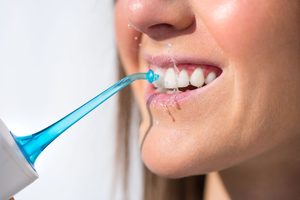
Although brushing your teeth twice daily helps clear away harmful plaque and bacteria, sources estimate that it leaves behind about 50% to 60% of residue buildup. Flossing is required to achieve a thorough clean to prevent common oral concerns, such as cavities and gum disease.
But many people dislike the sensation of floss between their teeth, while others have mobility challenges or other issues that make it hard to manipulate the string around their mouths. If you’re looking for an alternative option, you might do well with a water flosser instead. Continue reading to learn more about this option to decide which product is right for you!
What is a Water Flosser?
A water flosser, sometimes also referred to as an oral irrigator, is an electronically or battery-powered device that uses a gently pressurized stream of water to clean between your teeth and along your connective tissues. This can be ideal for patients who have other dental work, like dental crowns, bridges, veneers, or braces, that are known for being somewhat difficult to floss.
It can also help people with arthritis or limited mobility because these appliances typically have larger handles that are easier to hold and maneuver than string floss wrapped around the fingers.
Are Water Flossers More Effective Than Floss?
You’re not alone if you’re wondering whether water can remove plaque and bacteria more effectively than traditional floss. But a 2021 clinical trial found no statistically significant difference in the amount of residue an oral irrigator removes compared with traditional floss.
Some experts have even suggested that the pressurized water might be less effective because it might not reach the same areas that string floss can access, and the American Dental Association doesn’t generally recommend one option over the other, as long as you are getting a thorough cleaning.
Which Option is Right for Me?
It’s natural to wonder which product is best for you, but it depends on your unique circumstances and needs. For instance, if you frequently skip flossing because of adverse sensations, an oral irrigator might be less likely to trigger sensitivity or discomfort, making you more likely to use it consistently. You might even find that combining both options is the best way to remove buildup: use string floss to clear bacteria, then rinse the remnants away with a water flosser.
If you’re seeking professional recommendations to upgrade your at-home dental hygiene routine, your dentist can provide more accurate feedback based on your individual circumstances!
Meet the Author
Dr. J.D. Robison enjoys helping people of all ages enhance their dental health to improve their lives. He studied at Purdue University, the University of Michigan, and the University of Detroit Mercy, and today, he uses advanced technology to deliver a complete menu of services. He takes the time to get to know your unique concerns and goals, then delivers customized treatment plans to address them. If you’re concerned about gum disease, you can request an appointment on the website or by calling (734) 453-6320.